
firerouter/opus. In LiteLLM litellm_params.model, use fireworks_ai/accounts/fireworks/routers/firerouter/opus. Family names such as opus track the latest evaluated family version.
FireConnect is the easiest way to use Fireworks models in the coding harness you already use. It is an open-source CLI that rewrites your harness settings to call Fireworks, adds Fireworks models to the model picker, and restores your original settings when you turn it off. You do not need to host a service or edit config files by hand.
Command line
Claude Code
Codex CLI
OpenCode
Pi
Copilot CLI
DeepSeek
Claude Desktop
ChatGPT desktop app
Cursor IDE
VS Code
Copilot App
Quick start
Install
Alternative installer
Alternative installer
Sign in
Connect a harness
claude with any harness from Coding Harnesses. For Claude Desktop, run fireconnect claude-desktop on. For the ChatGPT desktop app, run fireconnect chatgpt; it shares a config with the Codex CLI, so it connects both. cursor means Cursor IDE only; Cursor CLI is not supported.Not sure of the name? Run fireconnect on its own and pick from the interactive menu. The ChatGPT desktop app is the codex row.Restart and check
status shows the configured model and the Fireworks models in the picker.Interactive menu
Runfireconnect with no arguments to pick a harness and an action from a menu:

Connecting Codex from the interactive menu
- Each harness shows its status:
on,off,off · detected(installed but not connected), ornot detected. - Use the arrow keys and Enter, or press 1-9 to pick a row directly. Esc goes back one menu, or exits from the top menu.
- Pick a harness, then
on,off, orstatus. Claude Code also offersusageandlive. configure,key, andhelpsit at the bottom of the list.- After the action runs, FireConnect prints the direct command, such as
fireconnect codex, so you can skip the menu next time.
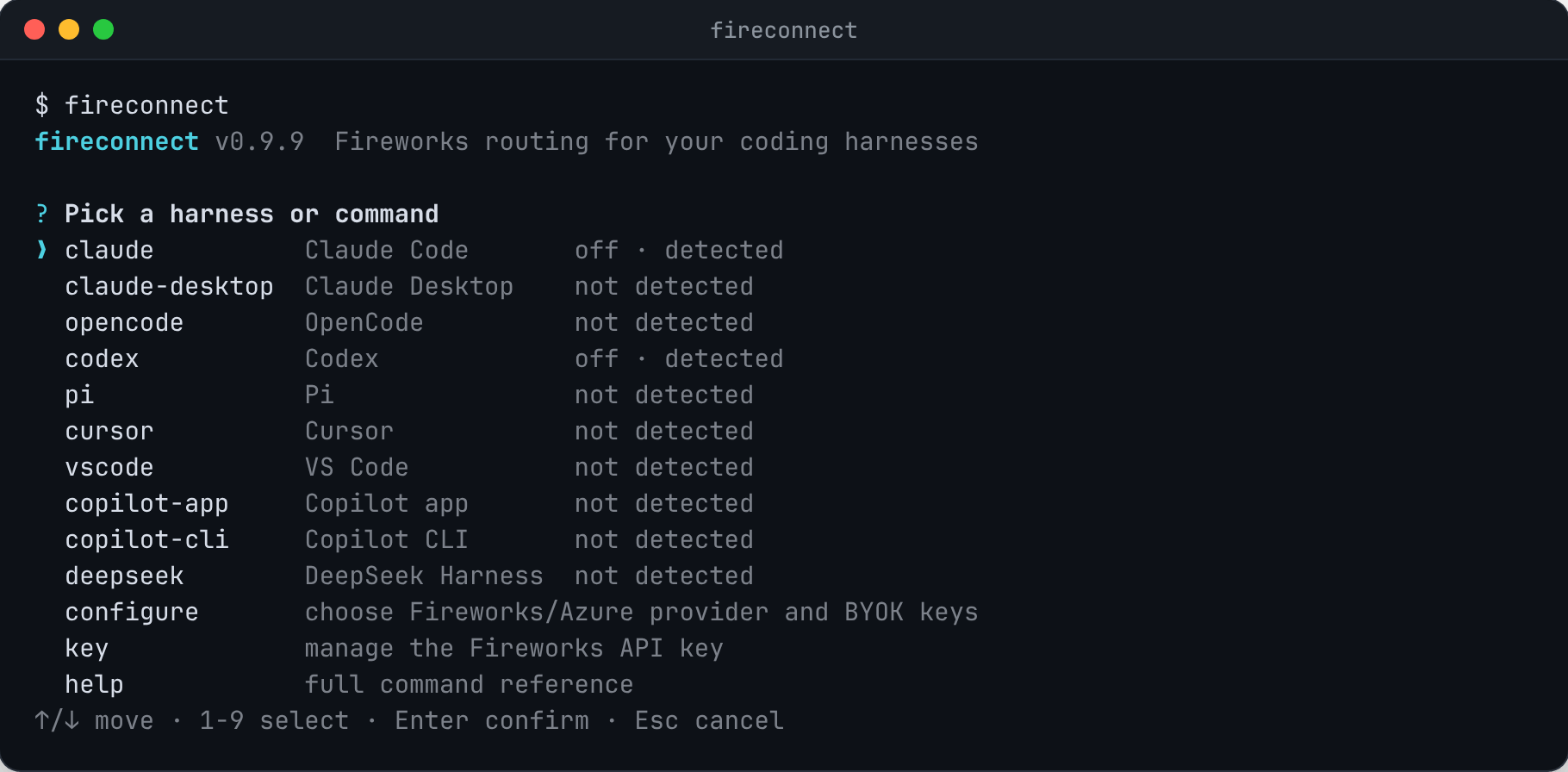
The FireConnect menu
In Claude Code
Runfireconnect claude, then start a new session and open /model. It lists auto, FireRouter, and the Fireworks models next to Claude Code’s own models:
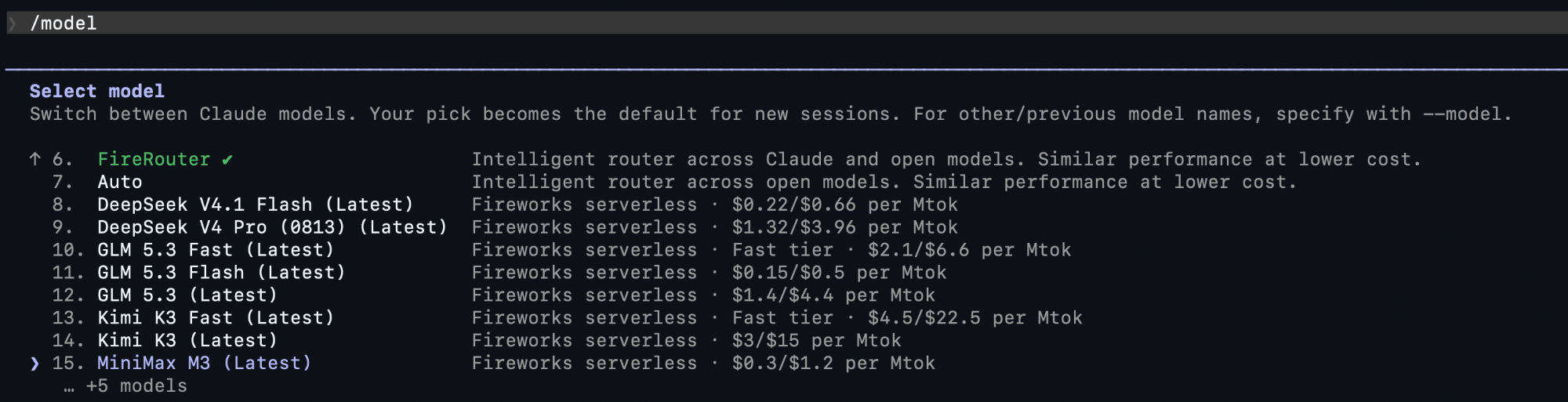
Fireworks models in the Claude Code model picker
In Codex
Close open Codex sessions, then connect:/model lists FireRouter, then Codex’s GPT models, then the Fireworks models:
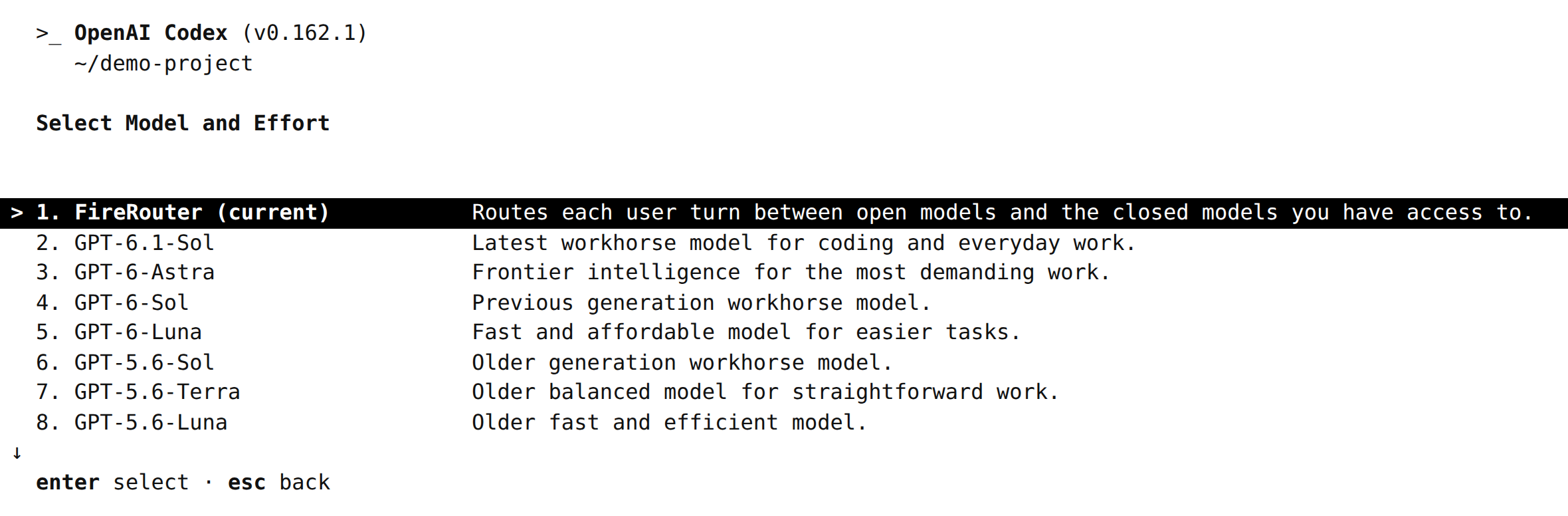
The Codex CLI /model picker after fireconnect codex
In the ChatGPT desktop app
Quit the ChatGPT desktop app, then connect:Connect and restore
- Connect rewrites the harness config to call Fireworks and saves a snapshot under
~/.fireconnect/. offrestores file-based harnesses from that snapshot byte-for-byte. For IDE databases, it removes the settings and models FireConnect added.fireconnect upgradeupdates FireConnect and brings connected harnesses up to date, keeping the model you picked. Restart each harness the upgrade output names.- Sign-in credentials and harness configurations are stored separately.
fireconnect loginsaves your credential through FireConnect’s secret store. If a harness requires the key in its own configuration, FireConnect copies it there and restricts the file permissions. Runfireconnect statusto see the active storage backend without revealing the key.
Choose a model
Connecting registers coding-ready Fireworks models, includingauto. Use --model to add or select a specific model:
fireconnect model list. See Open Models for aliases and pinned versions, and Coding Harnesses for app-specific rules.
To route each turn between open models and the Claude or GPT models you have access to, use FireRouter. FireRouter Setup covers the FireConnect command and the credentials each harness can send.
Web search
Web search works through Fireworks with no extra setup. In Claude Code, the nativeWebSearch and WebFetch tools run server-side on Fireworks. The Codex CLI and the ChatGPT desktop app keep their native web search. Search works with any Fireworks model or FireRouter ID. Web search pricing will be published soon; see Web Search.
Earlier FireConnect versions installed a
fireworks-websearch MCP server for
Claude Code. That MCP is no longer available. Run fireconnect upgrade to
remove it; your own MCP servers are not changed. See
Web Search.