> ## Documentation Index
> Fetch the complete documentation index at: https://docs.fireworks.ai/llms.txt
> Use this file to discover all available pages before exploring further.
# Managed Fine-Tuning Overview
> Fine-tune models with Fireworks-managed infrastructure — no custom code required.
Give Fireworks your data and configuration. The platform handles scheduling, training, checkpointing, and model output. Training data uses the **OpenAI-compatible chat completion format**, so existing OpenAI SFT datasets work with no conversion required.
## Methods
Train text models with labeled examples of desired outputs
Train vision-language models with image and text pairs
Align models with human preferences using pairwise comparisons
Train models using custom reward functions for complex reasoning tasks
## Free Reinforcement Fine-Tuning
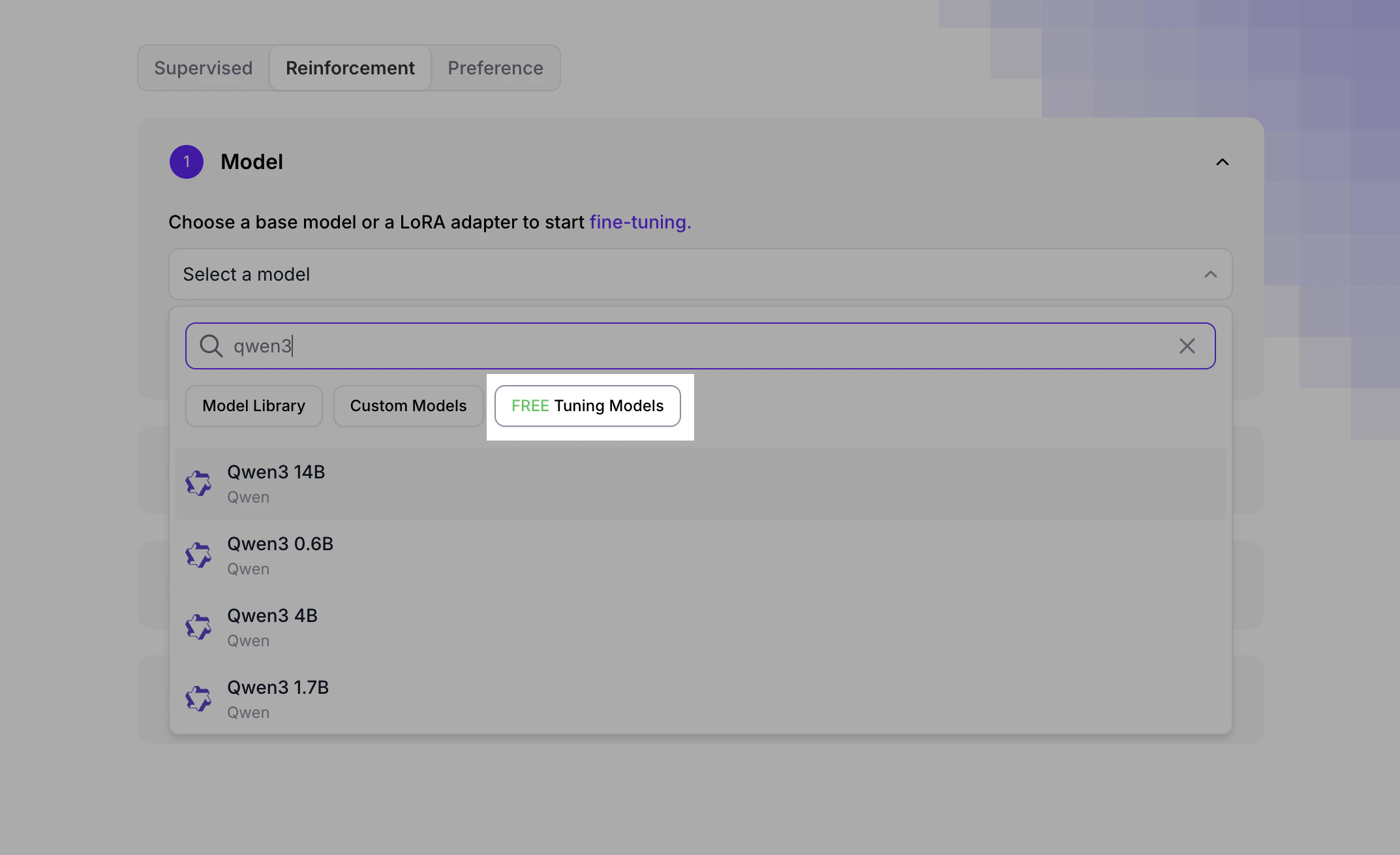
**Reinforcement Fine-Tuning (RFT)** is free for models under 16B parameters. When creating an RFT job in the UI, filter for free tuning models in the model selection area on the [fine-tuning creation page](https://app.fireworks.ai/dashboard/fine-tuning/create). If kicking off jobs from the terminal, you can find the model ID from the [Model Library](https://app.fireworks.ai/models?filter=LLM\&tunable=true). Note: SFT and DPO jobs are billed per training token for all model sizes—see the [pricing page](https://fireworks.ai/pricing) for details.
When creating a **Reinforcement Fine-Tuning** job in the UI, look for the "Free tuning" filter in the model selection area:
 For SFT and DPO pricing, see the [pricing page](https://fireworks.ai/pricing).
## Supported base models
Fireworks supports fine-tuning for most major open source models, including DeepSeek, Qwen, Kimi, Gemma, GLM, and Llama families. The same set of base models is available for SFT, DPO, and RFT — once a base model is supported, every managed fine-tuning method works against it.
The table below is generated from the live training shape registry. The "Max supported context length" is the largest `max_supported_context_length` across all training shapes registered for that base model — use it as the upper bound when you set a per-job context length on `firectl sftj create`, `firectl dpoj create`, or RFT job creation.
| Base model | Max supported context length |
| ------------------------------- | ---------------------------- |
| `gemma-4-26b-a4b-it` | 256K (262,144 tokens) |
| `gemma-4-31b-it` | 256K (262,144 tokens) |
| `glm-5p1` | 200K (200,000 tokens) |
| `kimi-k2p5` | 256K (262,144 tokens) |
| `kimi-k2p6` | 256K (262,144 tokens) |
| `llama-v3p3-70b-instruct` | 128K (131,072 tokens) |
| `minimax-m2p5` | 192K (196,608 tokens) |
| `nemotron-nano-3-30b-a3b` | 256K (262,144 tokens) |
| `qwen3-235b-a22b-instruct-2507` | 128K (128,000 tokens) |
| `qwen3-30b-a3b` | 128K (131,072 tokens) |
| `qwen3-30b-a3b-instruct-2507` | 128K (128,000 tokens) |
| `qwen3-32b` | 128K (131,072 tokens) |
| `qwen3-4b` | 64K (65,536 tokens) |
| `qwen3-8b` | 256K (256,000 tokens) |
| `qwen3-vl-8b-instruct` | 256K (262,144 tokens) |
| `qwen3p5-27b` | 256K (262,144 tokens) |
| `qwen3p5-35b-a3b` | 256K (262,144 tokens) |
| `qwen3p5-397b-a17b` | 256K (262,144 tokens) |
| `qwen3p5-9b` | 256K (262,144 tokens) |
| `qwen3p6-27b` | 256K (262,144 tokens) |
To browse the broader catalog (including non-tunable inference models), visit the [Model Library for text models](https://app.fireworks.ai/models?filter=LLM\&tunable=true) or [vision models](https://app.fireworks.ai/models?filter=vision\&tunable=true).
## Tuning modes and context length
Managed fine-tuning supports both **[Low-Rank Adaptation (LoRA)](https://arxiv.org/abs/2106.09685)** and full-parameter tuning, depending on the model, method, and selected training shape. It also supports the full context lengths exposed by the available training shapes, matching the same long-context capabilities used by cookbook recipes.
Choose LoRA when you want efficient adapter training and flexible deployment, including [multiple LoRAs](/fine-tuning/deploying-loras#multi-lora-deployment) on a single base model deployment. Choose full-parameter tuning when you need to update all model weights for difficult reasoning, alignment, or domain adaptation tasks.
**Deprecation notice:** The `deployedModel` request key for routing to LoRA addons is deprecated and will not be supported for any new deployments. Please migrate to the `model` field with the `#` format described in [Routing requests to LoRA addons](/fine-tuning/deploying-loras#routing-requests-to-lora-addons).
For SFT and DPO pricing, see the [pricing page](https://fireworks.ai/pricing).
## Supported base models
Fireworks supports fine-tuning for most major open source models, including DeepSeek, Qwen, Kimi, Gemma, GLM, and Llama families. The same set of base models is available for SFT, DPO, and RFT — once a base model is supported, every managed fine-tuning method works against it.
The table below is generated from the live training shape registry. The "Max supported context length" is the largest `max_supported_context_length` across all training shapes registered for that base model — use it as the upper bound when you set a per-job context length on `firectl sftj create`, `firectl dpoj create`, or RFT job creation.
| Base model | Max supported context length |
| ------------------------------- | ---------------------------- |
| `gemma-4-26b-a4b-it` | 256K (262,144 tokens) |
| `gemma-4-31b-it` | 256K (262,144 tokens) |
| `glm-5p1` | 200K (200,000 tokens) |
| `kimi-k2p5` | 256K (262,144 tokens) |
| `kimi-k2p6` | 256K (262,144 tokens) |
| `llama-v3p3-70b-instruct` | 128K (131,072 tokens) |
| `minimax-m2p5` | 192K (196,608 tokens) |
| `nemotron-nano-3-30b-a3b` | 256K (262,144 tokens) |
| `qwen3-235b-a22b-instruct-2507` | 128K (128,000 tokens) |
| `qwen3-30b-a3b` | 128K (131,072 tokens) |
| `qwen3-30b-a3b-instruct-2507` | 128K (128,000 tokens) |
| `qwen3-32b` | 128K (131,072 tokens) |
| `qwen3-4b` | 64K (65,536 tokens) |
| `qwen3-8b` | 256K (256,000 tokens) |
| `qwen3-vl-8b-instruct` | 256K (262,144 tokens) |
| `qwen3p5-27b` | 256K (262,144 tokens) |
| `qwen3p5-35b-a3b` | 256K (262,144 tokens) |
| `qwen3p5-397b-a17b` | 256K (262,144 tokens) |
| `qwen3p5-9b` | 256K (262,144 tokens) |
| `qwen3p6-27b` | 256K (262,144 tokens) |
To browse the broader catalog (including non-tunable inference models), visit the [Model Library for text models](https://app.fireworks.ai/models?filter=LLM\&tunable=true) or [vision models](https://app.fireworks.ai/models?filter=vision\&tunable=true).
## Tuning modes and context length
Managed fine-tuning supports both **[Low-Rank Adaptation (LoRA)](https://arxiv.org/abs/2106.09685)** and full-parameter tuning, depending on the model, method, and selected training shape. It also supports the full context lengths exposed by the available training shapes, matching the same long-context capabilities used by cookbook recipes.
Choose LoRA when you want efficient adapter training and flexible deployment, including [multiple LoRAs](/fine-tuning/deploying-loras#multi-lora-deployment) on a single base model deployment. Choose full-parameter tuning when you need to update all model weights for difficult reasoning, alignment, or domain adaptation tasks.
**Deprecation notice:** The `deployedModel` request key for routing to LoRA addons is deprecated and will not be supported for any new deployments. Please migrate to the `model` field with the `#` format described in [Routing requests to LoRA addons](/fine-tuning/deploying-loras#routing-requests-to-lora-addons).